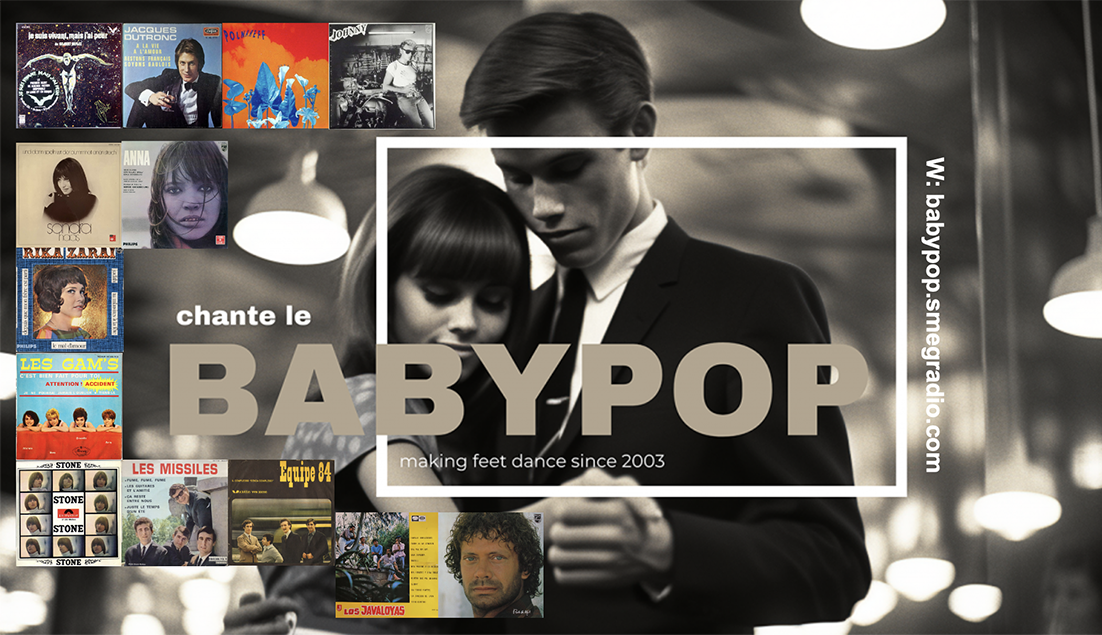
Babypop is a sixties Euro and French music podcast brought to you by the Babypop crew and hosted by Dj Ringfinger. Building on the success of the Good, the Bad and the Ugly podcast which started in 2012, Babypop will take your body and mind to the dance floors of the best clubs in Europe, filled with swinging beats, fuzzed out sounds, dusty grooves and the smell of cool (and Gitánes) leaching from every wall. This is Babypop!
A journey across European pop, ye-yé, and rock from the 1960s through the late 20th century, this collection captures a vivid cross-section of continental music history—spanning France, Germany, Italy, Spain, and the Netherlands.
Gilbert Deflez – L’agonie (France, 1974)
Jacques Dutronc – Restons Français, Soyons Gaulois (France, 1970)
Michel Polnareff – Besoin De Toi (France, 1990)
Johnny Hallyday – Je Peux Te Faire L’Amour (France, 1981)
Sandra Haas – Kleiner Mann (Germany, 1973)
Anna Karina – Roller Girl (France, 1967)
Rika Zarai – Depuis Que Mon Frère Est Parti (France, 1966)
Les Gams – Attention! Accident! (France, 1963)
Stone – Fille Ou Garçon (France, 1966)
Stone – Les Framboises (France, 1966)
Les Missiles – Fume Fume Fume (France, 1964)
Equipe 84 – Prima Cominciare (Italy, 1965)
Los Javaloyas – Buenas Vibraciones (Spain, 1967)
Rob De Nijs – Bang (Netherlands, 1978)
From France’s prolific chanson and pop scene, Gilbert Deflez’s “L’agonie” (1974) stands as a lesser-known but evocative recording from the mid-70s, a period marked by stylistic shifts toward more introspective songwriting. Jacques Dutronc, a defining voice of late-60s French pop, delivers sharp cultural commentary in “Restons Français, Soyons Gaulois” (1970), reflecting his signature blend of irony and social observation.
By contrast, Michel Polnareff’s “Besoin De Toi” (1990) comes from his later career resurgence after years spent in the United States, showcasing his continued flair for dramatic, melodic composition. Meanwhile, rock icon Johnny Hallyday—often called the “French Elvis”—brings polished 1980s production to “Je Peux Te Faire L’Amour” (1981), emblematic of his evolution from early rock’n’roll roots to mainstream pop stardom.
The 1960s selections highlight the vibrant ye-yé era. Actress and singer Anna Karina’s “Roller Girl” (1967) blends cinematic cool with pop sensibility, while Rika Zarai’s “Depuis Que Mon Frère Est Parti” (1966) reflects the era’s sentimental chanson tradition. Groups like Les Gams with “Attention! Accident!” (1963) and Les Missiles’s “Fume Fume Fume” (1964) capture the playful, youth-driven energy of early French pop.
Stone appears twice with “Fille Ou Garçon” and “Les Framboises” (both 1966), recordings from the early career of Annie Gautrat before her later success as part of the duo Stone & Charden.
Beyond France, the collection broadens geographically. Germany’s Sandra Haas contributes “Kleiner Mann” (1973), a Schlager-era track reflecting the genre’s accessible melodies and storytelling. Italy’s Equipe 84, one of the country’s leading beat groups, offer “Prima Cominciare” (1965), tied to Italy’s embrace of British-influenced rock. Spain’s Los Javaloyas bring a localized take on global pop trends with “Buenas Vibraciones” (1967), a Spanish-language interpretation of the international hit.
Finally, Dutch artist Rob de Nijs’s “Bang” (1978) represents a later European pop-rock sound, during a career that spanned decades and multiple stylistic reinventions.
Together, these recordings trace shifting musical styles—from early 60s pop experimentation to polished late-century production—while highlighting the diversity and cross-cultural influences that defined European popular music.